

Crypto security / explained
$6.3 billion. It started with a laptop.
On October 29, 2026, Binance, the world's largest crypto exchange, lost about $6.3 billion in the biggest crypto hack ever recorded. Ethereum was not broken and no cryptography was cracked. Here is how it actually happened, step by step.
What happened
Not a crash. A theft.
On the evening of October 29 (UTC), funds started leaving Binance's hot wallets, the online wallets an exchange uses to process everyday withdrawals. Within hours, Binance suspended deposits and withdrawals.
Binance's own estimate put the loss at roughly $6.3 billion, making it the largest crypto hack to date (CoinDesk, Bloomberg, NBC News). Analytics firms have given slightly different totals, which is normal this early, so treat every number in this story as preliminary.
The surprising part is not the size. It is where the attack began.
How it started
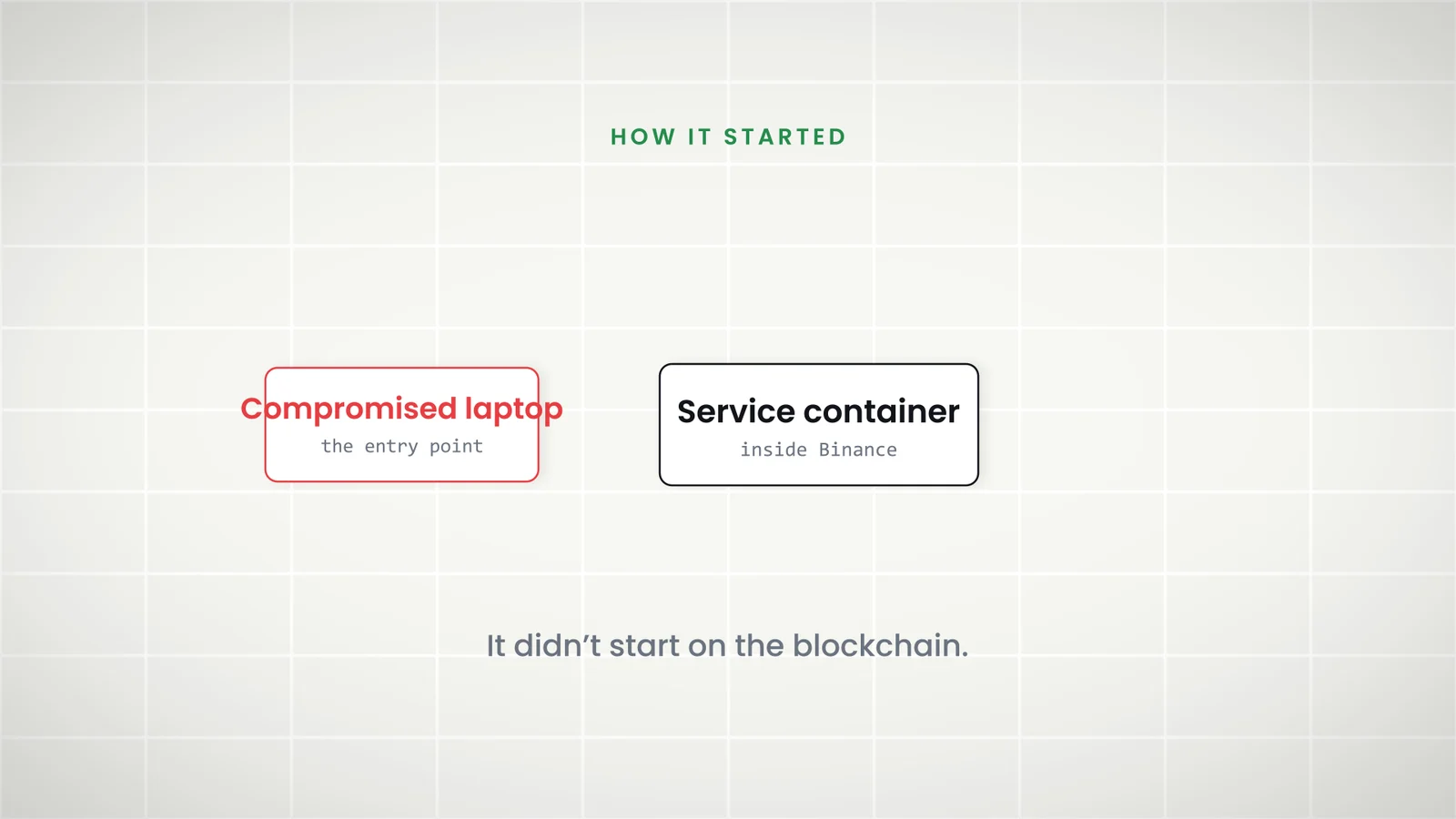
It did not start on the blockchain.
Binance's first statement said the attack came from a compromised engineer's laptop. Its fuller account on November 3 described a campaign built over many months.
A poisoned package
An engineer installed a tampered software package while looking for an AI tool. Binance caught it and replaced the device, but the engineer and their wallet-team colleagues stayed exposed (CoinDesk).
A fake job interview
A Binance software engineer was approached on a real job platform by someone posing as a project director. After a video interview with a fake HR contact, a supposed CEO asked him to download a coding assignment onto his work computer. It contained zero-day malware that got past endpoint security.
Moving sideways
Using that machine and an internal AI tool, the attackers reached the computers of two wallet engineers.
Inside the system
With stolen credentials, the attackers deployed a service container inside Binance's infrastructure and ran a malicious script. They did not need to steal a private key. They used Binance's own signing systems against it.
The weapon
A real Ethereum feature called EIP-7702.
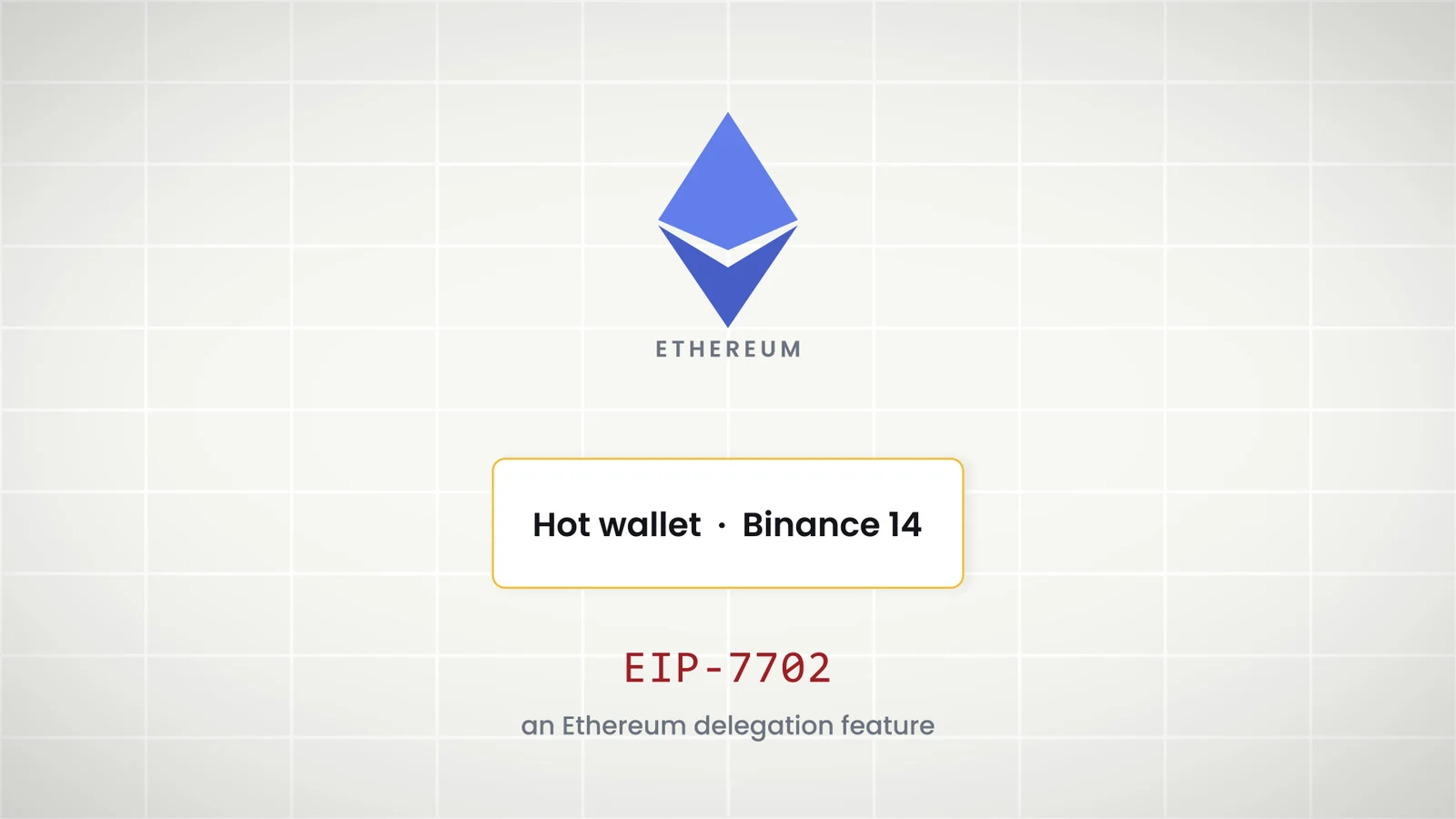
EIP-7702 is a recent Ethereum upgrade that lets a normal wallet temporarily hand its logic to a smart contract. It exists to make wallets smarter: batching transactions, paying fees in other tokens, adding recovery rules.
Technically, the wallet owner signs an authorization. Once it is included in a transaction, the wallet's code points to a chosen contract, and any call to the wallet runs that contract's code.
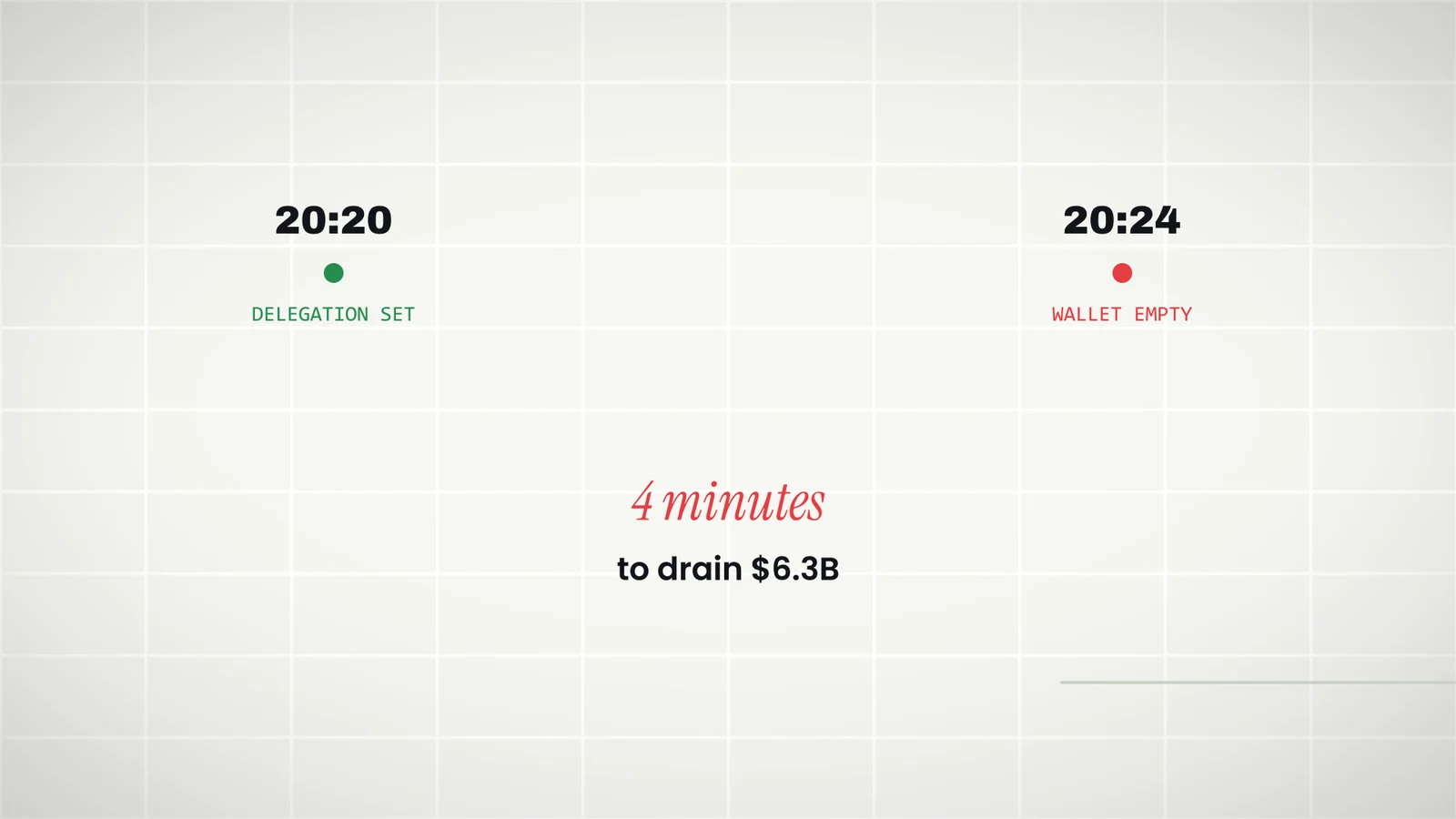
According to preliminary analysis from the security firm Blockaid, around 50 EIP-7702 authorizations targeted the hot wallet labeled "Binance 14". One matched the account's current nonce, which made it usable. The delegation went live at about 20:20 UTC, and the first sweep followed about four minutes later.
The aftermath
The money did not vanish.
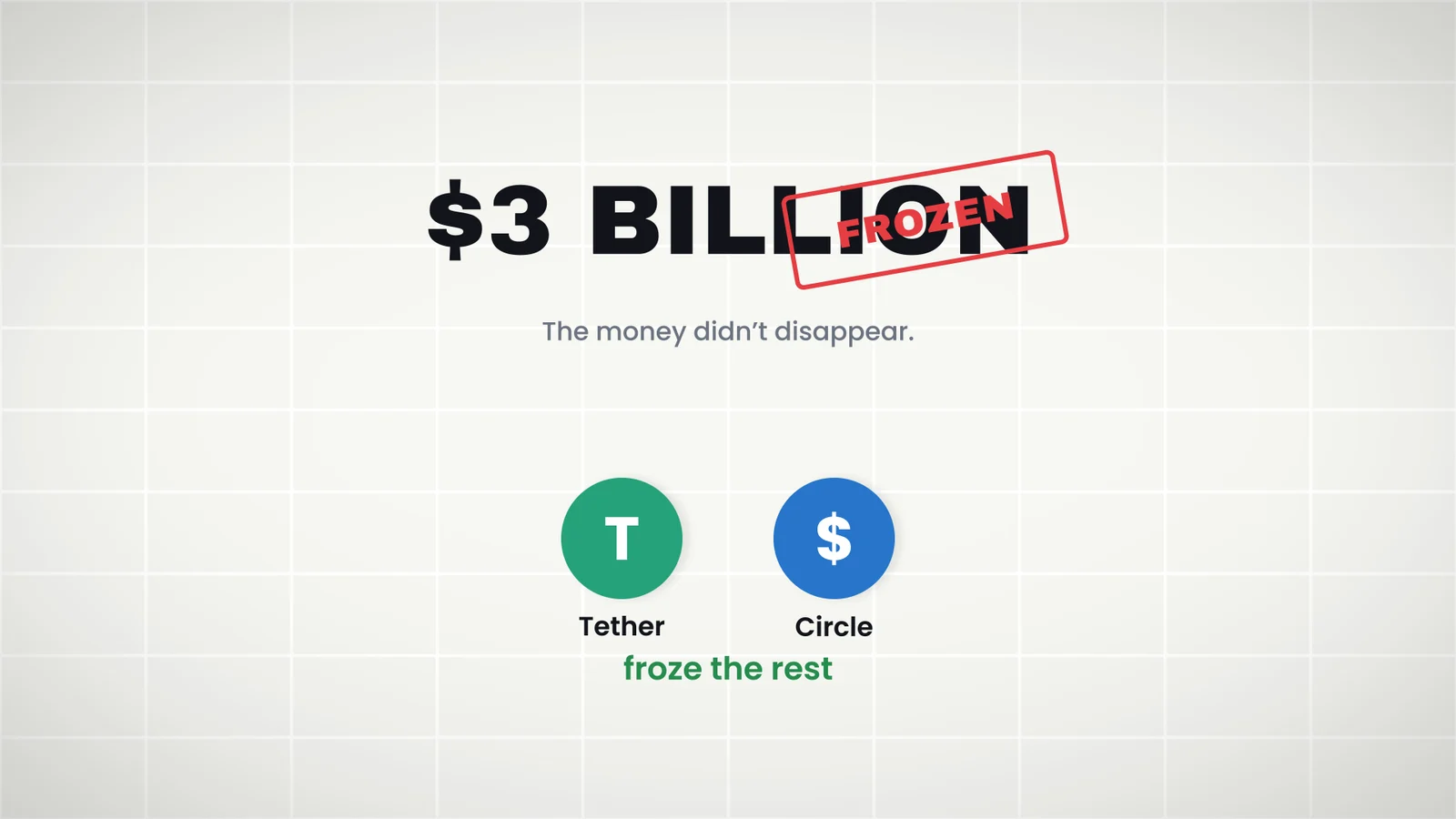
Blockchains are public, so the stolen funds could be followed in real time. Stablecoin issuers like Tether and Circle can freeze their own tokens, and they did. Binance put the frozen total at about $2.85 billion by November 3. Other estimates range from about $2.7 billion to $3 billion.
Binance hot wallets use multiparty computation (MPC), which spreads signing power across several parties so no single key controls them. That is normally a strength. Here it slowed the response, because no single key could revoke the attacker's access. Containment took until about 00:10 UTC on October 30.
On attribution, Binance CEO Richard Teng said the FBI attributed the attack to North Korea. Blockchain analytics firm TRM Labs linked it to the North Korean group known as TraderTraitor. North Korea has a long record of large crypto thefts, and fake job offers are one of its best-known entry methods.
What actually failed
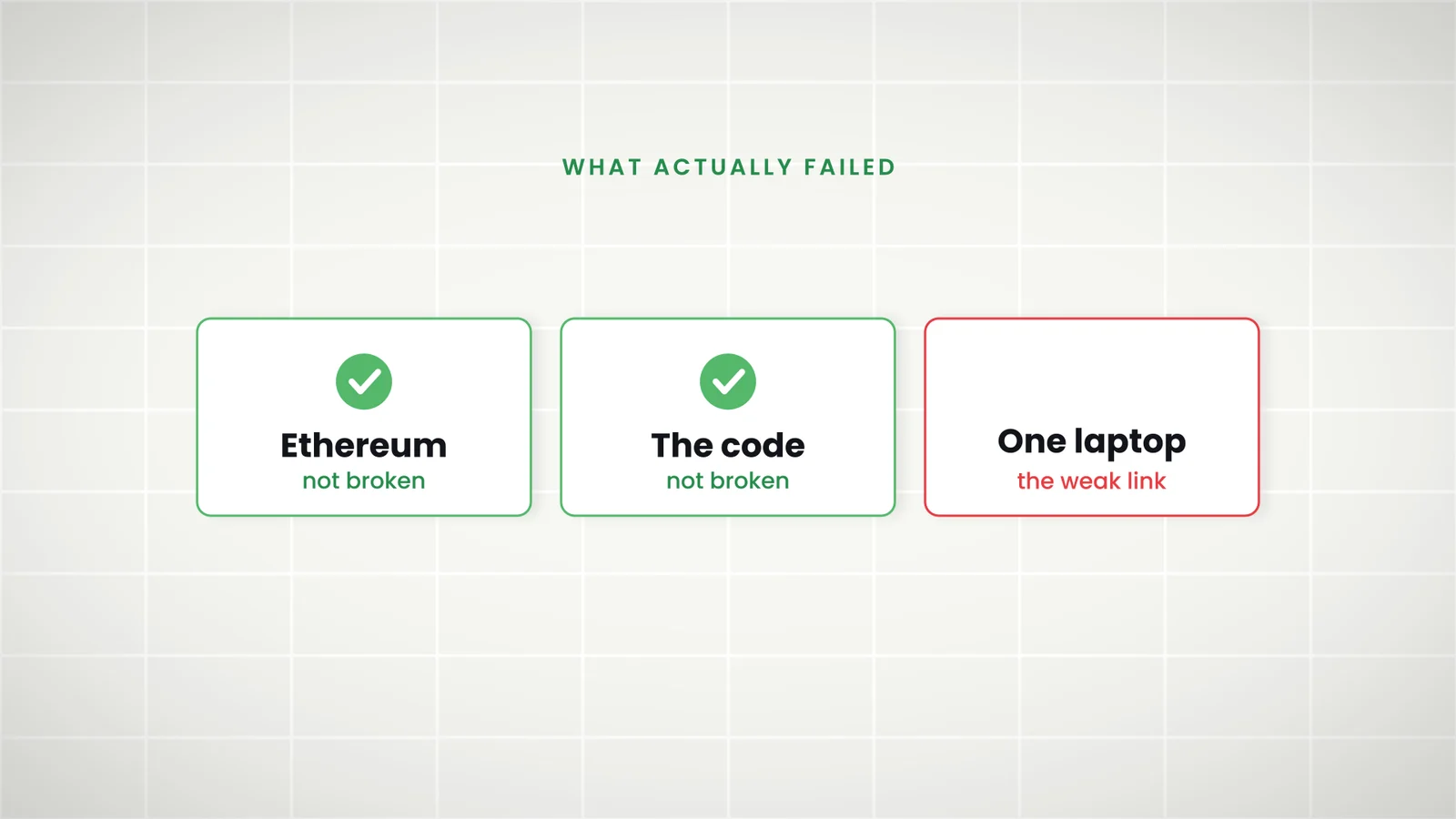
Ethereum did not break. Access did.
It is tempting to blame EIP-7702. But the feature did exactly what it was designed to do. The failure came earlier, at the human and operational level.
Ethereum
The blockchain processed valid, signed transactions. Nothing about the protocol was exploited.
The cryptography
No private key was cracked. The attackers got the system to sign for them.
One laptop, one set of permissions
A trusted engineer's machine, an internal tool with too much reach, and a signing system that trusted the wrong request.
Lessons
What any team can take from this.
You do not need to run an exchange for this to matter. The same chain of mistakes shows up in ordinary companies, especially now that AI tools and agents are wired into internal systems.
- Treat job-interview "take-home tasks" and unknown packages as untrusted code. Never run them on a work machine.
- Give every tool, including internal AI tools, the minimum access it needs. We cover this in how MCP permissions should work.
- Put a human approval or a hard limit in front of anything that can move money or change signing rules.
- Plan for revocation. Know how you would cut off access in minutes, not hours.
- If you hold crypto, remember that funds on an exchange are only as safe as that exchange's worst day.
The main idea
Not beaten by better code. Beaten by access.
The most advanced exchange in the world lost billions without a single line of cryptography failing. Binance's final postmortem is still to come, and some numbers may change. We will update this breakdown when it lands.
Watch the video breakdown on YouTube →Sources
- CoinDesk: Binance's $6.3B hack began with a fake job interview
- Forbes: Binance's $6.3B hack started with one engineer's laptop
- Gizmodo: How hackers stole $6.3B from Binance in minutes
- Yahoo Finance: North Korea linked to record theft
- Aikido: how a developer laptop can put $6.3B in play
- Ethereum EIP-7702 specification